

Can You Treat Chronic Knee Pain Without Surgery?
- Activliving Physio

- May 20
- 7 min read
If you have been living with persistent knee pain for months or years, the prospect of surgery can feel like it is looming on the horizon. Perhaps your GP has mentioned it. Perhaps you have heard the phrase "bone on bone" and assumed that an operation is only a matter of time. For many people with chronic knee pain, that assumption is understandable, but it is also frequently wrong.
The evidence is clear: the vast majority of people with chronic knee pain — including those with moderate to severe osteoarthritis — can achieve meaningful, lasting improvement without going under the knife. For those who do eventually need surgery, a structured non-surgical programme first makes the operation more successful and recovery faster. Either way, surgery is rarely the right first step, and at Activliving in Preston, it is never our starting point.
What Do We Mean by Chronic Knee Pain?
Chronic knee pain is generally defined as pain that has been present for three months or more. It is distinct from the sharp, sudden pain of an acute injury — a torn ligament after a tackle, for example — though the two can overlap if an old injury was never properly rehabilitated.
The most common underlying causes of chronic knee pain in adults include:
Osteoarthritis — the gradual wearing of cartilage that cushions the knee joint, most common in people over 45 but not exclusively
Patellofemoral pain syndrome — pain around or behind the kneecap, often described as a dull ache that worsens with stairs, squatting, or sitting for extended periods
Bursitis — inflammation of the small fluid-filled sacs that cushion the joint
IT band syndrome — tightness and friction along the outer knee, common in runners and cyclists
Meniscal degeneration — age-related wear of the cartilage pads inside the joint, which can cause pain without a specific injury
Each of these responds differently to treatment, which is why a thorough assessment matters before any treatment plan is put in place. Knowing that your knee hurts is not enough — understanding why it hurts determines what will actually work.
What the Clinical Evidence Actually Says
The National Institute for Health and Care Excellence (NICE) is the body that sets clinical standards for treatment in England. Its guideline on osteoarthritis (NG226) is unambiguous: first-line management should consist of exercise, physical therapy, and where appropriate, weight management. Surgery is considered only when these approaches have been properly pursued and have not provided sufficient relief.
NICE suggests that clinicians should be conservative with medication and use it as a second-line treatment, with first-line management consisting of exercise, physical therapy and, if the patient is overweight, weight reduction.
Clinical guidelines recommend at least six months of conservative management, including physiotherapy, for patients with symptomatic knee osteoarthritis prior to surgery.
This is not a counsel of patience for its own sake. It reflects something important: structured non-surgical treatment works. Research consistently shows that targeted exercise and physiotherapy reduce pain, improve function, and for a significant proportion of patients, remove the need for surgical intervention altogether.
Non-Surgical Treatments That Make a Real Difference
Physiotherapy and Exercise Rehabilitation
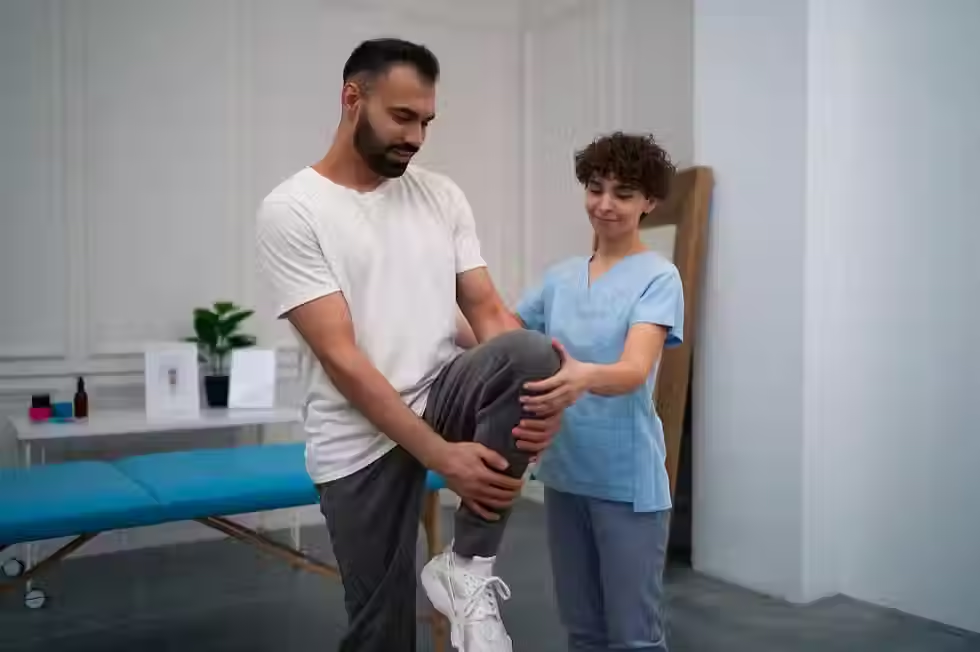
The most robust evidence in knee pain management points to one intervention above all others: exercise. Not just any exercise — a structured, progressive programme tailored to the specific presentation of your knee, designed and supervised by a qualified physiotherapist.
The mechanism is straightforward. The muscles surrounding the knee — particularly the quadriceps at the front of the thigh, the hamstrings at the back, and the gluteal muscles of the hip — act as shock absorbers for the joint. When these muscles are weak, the joint itself bears disproportionate load. Strengthening them redistributes that load, reduces pain, and improves stability.
There is considerable evidence for the benefits of non-surgical management of knee osteoarthritis via targeted multidisciplinary programmes. Guidelines consistently include education, land-based exercise, and weight management as part of first-line care, and this early conservative management has been shown to improve quality of life and prevent many patients from requiring joint replacement surgery.
At Activliving, every patient receives a bespoke assessment before any exercise programme begins. The programme is built around your specific knee presentation, your fitness level, and your daily life — because a retired teacher in Preston managing osteoarthritis needs a different programme from a forty-year-old runner with patellofemoral pain.
One important note: it is normal for knee pain to increase slightly when you first begin a supervised exercise programme. This is addressed in NICE's own guideline, which advises patients that doing regular and consistent exercise, even though this may initially cause pain or discomfort, is important for longer-term improvement. A good physiotherapist will guide you through this phase and ensure you are progressing safely.
Manual Therapy
Manual therapy refers to hands-on techniques including joint mobilisation, joint manipulation, and soft tissue work. In the context of chronic knee pain, it is used alongside exercise — not as a standalone treatment — to improve range of motion, reduce joint stiffness, and address the surrounding soft tissues that can contribute to pain patterns.
It is particularly useful for patients whose knee pain is accompanied by morning stiffness, restricted bending, or tightness extending into the hip or lower leg. In many cases, what presents as a knee problem has contributing factors in the hip or lumbar spine that manual therapy helps address.
Injection Therapy — Corticosteroid and Hyaluronic Acid
Injection therapy is one of Activliving's key differentiators as a private physiotherapy clinic in Preston. We administer two types of injection for chronic knee pain, and the distinction between them matters.
Corticosteroid injections work by delivering a powerful anti-inflammatory agent directly into the knee joint. The evidence for short-term pain relief is well-established: on the short term, up to four weeks, clear efficacy has been seen, with effects clearly diminishing by three months. They work best for patients experiencing an inflammatory flare — significant swelling, warmth, and acute-on-chronic pain — where getting inflammation under control is the priority. The goal is not simply to provide pain relief in isolation, but to create a window of reduced pain in which the patient can engage productively with physiotherapy and exercise rehabilitation.
Hyaluronic acid (viscosupplement) injections work through a different mechanism. Rather than suppressing inflammation, they supplement the natural synovial fluid that lubricates the joint — fluid that diminishes as osteoarthritis progresses. Viscosupplementation appears to have a slower onset of action than intra-articular steroids, but the effect seems to last longer, with some studies reporting beneficial effects at five to thirteen weeks post-injection.
It is worth being transparent about the evidence here: guidelines are not uniform on hyaluronic acid. NICE's current guidance does not recommend it as a routine treatment for knee osteoarthritis, while other international bodies such as OARSI and EULAR take a more conditional view, particularly for patients with early-to-moderate osteoarthritis where moderate efficacy in pain relief and functional improvement has been demonstrated. At Activliving, we discuss this nuance directly with patients. Injection therapy — whether corticosteroid or hyaluronic acid — is always administered as part of a broader treatment plan, and the decision about which approach suits a particular patient depends on the nature of their knee condition, their symptom profile, and their treatment history.
Critically, neither type of injection requires a hospital referral. Patients in Preston and across Lancashire can access this treatment directly at our clinic, without the delays that often accompany NHS referral pathways.
Chronic Pain Management
When knee pain has been present for a year or more, something important changes in the way the nervous system processes it. Pain signals can become amplified and persist even when the underlying joint damage would not be expected to generate pain of that intensity. This is not psychological — it is a well-documented physiological process, and it requires a different treatment approach.
Activliving's chronic pain management addresses this dimension of long-standing knee pain directly. The approach is multi-modal: combining manual therapy, carefully progressed exercise, patient education about pain science, and where appropriate, injection therapy to break a cycle of pain and avoidance. This is the service that makes the most difference for patients who have tried standard physiotherapy elsewhere and found only partial improvement — because partial improvement, when chronic pain mechanisms are at play, often means the treatment was not addressing all the relevant factors.
When Surgery Is the Right Answer
Honest clinical advice requires acknowledging that surgery is sometimes necessary. Certain presentations — complete ligament rupture, severe structural joint damage, or end-stage osteoarthritis where virtually no cartilage remains and the patient's quality of life is significantly compromised despite exhaustive conservative management — are legitimate surgical candidates.
If our assessment suggests that you are in this category, we will tell you plainly. Our job is to find the best outcome for you, not to keep you in treatment indefinitely.
For patients who do proceed to surgery, it is worth knowing that physiotherapy beforehand — often called prehabilitation — significantly improves post-operative outcomes. Patients who arrive for knee replacement with stronger surrounding muscles and better joint mobility recover faster and achieve better functional results. Activliving offers post-surgical rehabilitation for patients both before and after orthopaedic procedures.
Where to Start
The answer to whether your chronic knee pain can be treated without surgery almost always comes down to one thing: a thorough, honest assessment of what is actually causing it.
Not all knee pain is the same. Not all treatment responses are the same. What works reliably for osteoarthritis in a 62-year-old may be entirely wrong for patellofemoral syndrome in a 44-year-old runner. Getting this right at the start is what determines whether the months ahead involve meaningful improvement or more of the same frustration.
At Activliving, our private physiotherapy clinic in central Preston, we offer comprehensive knee assessments with no GP referral required. Appointments are available Monday to Friday. We accept patients under most major insurance policies including Vitality, Aviva, Simplyhealth, Westfield Health, Medicash, BHSF, and Health Shield, and we see self-paying patients across Preston and the wider Lancashire area.
If you have been told surgery is the next step, or if you are simply tired of managing knee pain that is limiting your daily life, come and find out what non-surgical treatment can actually do for you.
Book an assessment at Activliving today.


Comments